Showing posts with label nostalgia. Show all posts

Saturday, May 21

If you can read this, thank a teacher

Hopefully everyone has at least one teacher who has made a difference.

At least one teacher who believed in you.

At least one teacher who thought you were everything you thought you could be - and then some.

For Momma, that teacher was Gerri B. Fiedler. And today was Mrs. Fiedler's memorial service.

Momma first met Mrs. Fiedler in the spring of 1979. Momma had a crush and started hanging around the journalism room at Coronado High School in Scottsdale, Arizona.

The crush faded in time, but her love of writing and photography grew and was nurtured under Frau Fiedler's tender relentless tutelage.

All Momma really needed to know she learned in Gerri Fiedler's classes. 

This was "old school" journalism: Typewriters, 35mm cameras, darkrooms, carbon paper, newsprint, rubber cement, pica poles, late nights, early mornings, deadlines, pizza.

Frau Fiedler was always there, whether it was 6 a.m. or midnight.

Mrs. Fiedler was always there.

It has been 34 years since Momma graduated from high school, but Momma never forgot Frau Fiedler and Frau never forgot Momma - or any of her kids.

Momma would call her every now and then to share life events. Frau Fielder would call every now and then - especially after seeing Momma's byline.

She was always so proud of her kids.

Frau Fiedler was always there for her kids.

And now she's not. 

We'll see you again at the great newsroom in the sky.


Feb. 21, 1930 - April 29, 2016


Tuesday, March 11

Hanging with my Peeps


Pippaloo
Momma has gone into Nostalgic Overdrive with the two newest offerings by Pippaloo and Mini Me Dolly Divas.

Peeps!

Ahem.

Mini Me Dolly Divas
Momma has loved Peeps ever since she was a child and her grandfather brought her a box of yellow chick Peeps and a 64-count box of Crayola Crayons.

So she nearly squee-ed today when she saw Dacia's newest T-shirt idea and Teresa's March food offering.

Peeps!

I don't think she will ever recover from this.


Tuesday, January 28

Dolly'll never go away again

As previously mentioned, Momma has never cared for blond, blue-eyed dolls.

Maybe it was because she was a brunette, brown-eyed girl.

Or maybe it was because of all of the blond, blue-eyed dolls on the market in the late '60s and early '70s when she was in her formative doll years.

Almost all the dolls she saw of that era were blue-eyed blondes - at least in the town she grew up in. Momma had Ideal's Velvet and Mia (she preferred the brunette Mia) and didn't even know there was an African American Chrissy until she was an adult.

She and her brother both collected Marx's "Best of the West" and
her brother collected their "Noble Knights and Vikings" action figures. Momma had Jane, Janice, and Josie West, as well as Princess Wildflower, while her brother collected the males in both lines. (Momma would have liked to collect girls from the "Noble Knights and Vikings" but there was none.)

At the end of her doll-playing days (but not collecting!) she had Mattel's entire Sunshine Family and Happy Family lines - mostly because she liked the multicultural and multi-generational aspect of the dolls. (Mattel did not make a "Black" Barbie until 1980!)

But her biggest regret? Not keeping the two Barbies given to her by her older cousins.

Why? Her cousins are 6 to 12 years older than Momma and gave her two of the earliest Barbies when they outgrew them!

Sadly, Momma did not like what she now thinks was a 1961 Mattel Barbie Titian-Hair Bubble-Cut Barbie, and what was possibly the first 1959 Teenage Fashion Model Blonde Barbie.

Momma disliked them so much she dressed them in white slips (yes, they made dolls wear slips back then) and forced them into domestic servitude for her Mod and Malibu Barbies.

Snigger.


Monday, January 27

Steampunk Addie's Improbable History


It probably will come as no surprise that Momma and I are both looking forward to the upcoming moving picture, Mr. Peabody & Sherman. 

Mr. Peabody & Sherman is a computer-animated adventure comedy film based upon the characters from the Peabody's Improbable History segments of the 1959-1964 animated television series, The Rocky and Bullwinkle Show

Although the television show ended days before Momma was born, watching reruns was an anticipated event in her life. 

The Rocky & Bullwinkle Show (known as Rocky & His Friends during its first two seasons and as The Bullwinkle Show for the remaining seasons) featured the serialized adventures of the two title characters, Bullwinkle the moose and Rocky the squirrel.


Supporting segments included Dudley Do-Right (a parody of old-time melodrama), Peabody's Improbable History (a dog and his pet boy Sherman traveling through time), and Fractured Fairy Tales (classic fairy tales retold in comic fashion), among others.

Rocky & Bullwinkle was known for its quality writing and wry humor. Mixing puns, cultural and topical satire, and self-referential humor, it appealed to adults as well as children.

That is why we are looking forward to the moving picture's (re)scheduled March 7, 2014, release.

Mr. Peabody, the most accomplished dog in the world, and his mischievous boy Sherman, use their time machine - The WABAC - to go on the most outrageous adventures known to man or dog. But when Sherman takes The WABAC out for a joyride to impress his friend Penny, they accidentally rip a hole in the universe, wreaking havoc on the most important events in world history. Before they forever alter the past, present and future, Mr. Peabody must come to their rescue, ultimately facing the most daunting challenge of any era: figuring out how to be a parent. Together, the time traveling trio will make their mark on history.


Are you ready to leave your mark on history?


Friday, June 22

Cute as a Bug on a rug

American Girl
Momma is seriously geeking out this week.

American Girl leaked that one of its new releases on June 28 is Julie's Car Wash Set ... featuring a Volkswagen Beetle!!!

The Volkswagen Beetle, officially called the Volkswagen Type 1 (or informally the Volkswagen Bug), was an economy car produced by the German auto maker Volkswagen (VW) from 1938 until 2003.

Momma's parents got their first (yellow) Bug while she was in Kindergarten (1969-1970). It was quickly followed by a pale blue Bug.

Grandmomma learned to drive stick-shift on the yellow Bug while driving Momma to kindergarten. (Grandmomma and her best friend once drove from Ohio to Florida in one of the Bugs with four kids!) Ten years later Momma learned how to drive stick-shift on the same yellow Bug.

Sadly, Momma killed that poor yellow Bug in a car accident in 1982. (The fire department had to cut the roof off to extricate Momma, briefly creating the only VW bug convertible owned by her family.)

So while I'm busy creating a fake driver's license for me, Momma is praying the price for Julie's Car Wash Set will lower than the rumored $350.

Gulp.

If so, we'll be looking for one in the salvage yard.


Wednesday, January 11

Loco for the Grand Canyon

The first passenger train from Williams to the Grand Canyon on Sept. 17, 1901.

It seems surprising now, but it took more than 30 years for the Grand Canyon to become a national park. The first bills to create Grand Canyon National Park were introduced in 1882, 1883 and 1886 by then-senator Benjamin Harrison. As President, Harrison established the Grand Canyon Forest Reserve in 1893.

President Theodore Roosevelt visited the Grand Canyon rim in 1903 and exclaimed:
"The Grand Canyon fills me with awe. It is beyond comparison—beyond description; absolutely unparalleled throughout the wide world. ... Let this great wonder of nature remain as it now is. Do nothing to mar its grandeur, sublimity and loveliness. You cannot improve on it. But what you can do is to keep it for your children, your children's children, and all who come after you, as the one great sight which every American should see."
Roosevelt created the Grand Canyon Game Preserve in 1906 and Grand Canyon National Monument on Jan. 11, 1908. Senate bills to establish a national park were introduced and defeated (again) in 1910 and 1911. The Grand Canyon National Park Act was finally signed by President Woodrow Wilson in 1919. 

Part of what protected it for so long was its remoteness. A railroad to Flagstaff was completed in 1882 and stage coaches started to take tourists from Flagstaff to the Grand Canyon in 1883—a 70-mile, 11-hour journey at $20 per person.

The first train with paying passengers (the 64-mile trip cost $3.95) arrived on Sept. 17, 1901 from Williams.

Trains ran from Williams to the Grand Canyon until 1968. They returned 88 years after its maiden run to the day on Sept. 17, 1989.

For years the Grand Canyon Railway operated steam engines from Memorial Day to Labor Day, but they discontinued regular runs in 2008 because of environmental considerations. Operating a diesel fleet saves a lot of fuel and reduces greenhouse gas emissions and air pollutants associated with steam locomotives.

However, the Grand Canyon Railway commemorates its anniversary every September with a special round-trip run to the Grand Canyon using steam locomotive No. 4960 fueled by recycled vegetable oil! The steam locomotive also makes special trips throughout the year.

In honor of Arizona's centennial on Tuesday, Feb. 14, 2012, Grand Canyon Railway is offering round-trip coach class tickets for $7.50 per person - the same cost as in 1912! The Arizona Centennial Train will depart the Williams Depot at 9:30 a.m. for the Grand Canyon pulled by vintage steam locomotive 4960 with coach seating. 

You can be a part of this historic event by calling 1-800-THE-TRAIN or clicking here to order online.

Shall I see you there? All aboard!


Tuesday, January 10

Metropolis Ga Ga

If you have never seen a silent film, I beg you to start with Fritz Lang's Metropolis which was released Jan. 10, 1927 in Germany.

In a futuristic city sharply divided between the working class and the city planners, the son of the city's mastermind falls in love with a working class prophet who predicts the coming of a savior to mediate their differences. 

Considered by some to be an early precursor of steampunk, it is visually stunning - especially for the times. (While theoretically set in "the future" you can see 1920s cars in it - oops.)

The sci-fi epic ran an estimated 153 minutes
when it was first screened in Berlin but by the time it debuted in the United States later that year the film ran approximately 90 minutes. (Exact running times are difficult to determine because silent films were not always projected at a standardized speed).

Metropolis went on to become one of the cornerstones of science fiction cinema foreshadowing Blade Runner and The Matrix.

Most of what was cut was thought to be permanently lost or destroyed although small segments were found over the years. However, a copy was discovered in 2008 in Argentina that included 25 minutes of "lost" footage, about a fifth of the film, that had not been seen since its Berlin debut. That 145-minute restored version is now available on DVD.


Saturday, December 31

For auld lang syne

Methinks Robert Burns was hitting the Scotch when he wrote this New Year's Eve classic in 1788:

Should auld acquaintance be forgot,
and never brought to mind?
Should auld acquaintance be forgot,
and auld lang syne?
CHORUS:
For auld lang syne, my jo, for auld lang syne, we’ll tak a cup o’ kindness yet, for auld lang syne.
And surely ye’ll be your pint-stowp !
and surely I’ll be mine !
And we’ll tak a cup o’ kindness yet,
for auld lang syne.
CHORUS
We twa hae run about the braes,
and pu’d the gowans fine;
But we’ve wander’d mony a weary fit,
sin auld lang syne.
CHORUS
We twa hae paidl’d i' the burn,
frae morning sun till dine;
But seas between us braid hae roar’d
sin auld lang syne.
CHORUS
And there’s a hand, my trusty fiere!
and gie's a hand o’ thine!
And we’ll tak a right gude-willy waught,
for auld lang syne.
CHORUS
Aloha Kanani. 

Welcome McKenna!

Wednesday, December 28

On the fourth day of Christmas

On the fourth day of Christmas
My true love gave to me
Four calling birds
Three French hens, two turtle doves
And a partridge in a pear tree.

Dec. 28, 2000 was a sad date in retail history when U.S. retail giant Montgomery Ward announced it was going out of business after 128 years.

Montgomery Ward was founded by Aaron Montgomery Ward in 1872. Ward had conceived of the idea of a dry goods mail-order business in Chicago, Illinois, after several years of working as a traveling salesman among rural customers. The business grew at a fast pace over the next several decades, fueled by demand primarily from rural customers who were also attracted by the innovative and unprecedented company policy of "satisfaction guaranteed or your money back", which Ward began using in 1875.

Laura Ingalls Wilder fans recognize the importance Montgomery Ward catalogues had for those who lived far from the big city:

For themselves, they decided to buy a present together, something they could both use and enjoy. After much studying of Montgomery Ward’s catalogue, they chose to get a set of glassware. They needed it for the table and there was such a pretty set advertised, a sugar bowl, spoon-holder, butter dish, six sauce dishes, and a large oval-shaped bread plate. On the bread plate raised in the glass were heads of wheat and some lettering which read “Give us this day our daily bread.”

Laura Ingalls Wilder
The First Four Years

That breadplate was one of the very few things to survive the housefire that destroyed their home a few years later.

One of Momma's treasures includes an identical antique glass breadplate. (She loves to collect antique china and glass patterns mentioned in her favorite kidlit books. So far she has Laura's breadplate and Blue Willow china as well as Tacy's china pattern in a teacup and saucer. She's trying to hunt down a sandwich tray in Mrs. Ray's china pattern, too.)


Sunday, December 25

Happy Christmas to all, and to all a good night

I don't know about you but I am exhausted, and look rather like Randy in these two scenes from A Christmas Story.

Momma (and Santa) outdid themselves this year. This is what I got:


Golden Kung Fu Cannon
Launch an awesome assault! This Exclusive Fisher-Price Kung Fu Panda Golden Cannon with Wolf is an action packed cannon launcher! Load up the balls and aim at the targets. Press down on the cannon to fire! Includes: cannon, 3 balls, 3 targets and an exclusive Wolf figure.

Schylling Zeppelin Ornament


This Miniature Tin Toy Ornament was inspired by the classic tin toys from the 1920's and 30's. Making Tin Toys is a dying art. A single piece of this ornament can require 6 or more processes to create its final shape. Each ornament is then hand assembled from up to to 24 of these single pieces.

It is easy to see why tin toys were quickly abandoned when plastic was developed. Now, tin toys are sought after by collectors around the world.


Uglydoll - 4" Ice-Bat Clip
Wage, Babo, and the Uglydolls decide to go on a sort of Ninja type mystery adventure...a sort of quest. The mission? You know the cookies and snack foods youve been munching on? Yeah they want some of those. Or more than just some. Probably all. Ice-Bat lives in the freezer. Yeah but can he crash at your freezer while he's on this whole Ninja mystery mission adventure dealio? 


God bless us, every one!

On the first day of Christmas

On the first day of Christmas
My true love gave to me
A partridge in a pear tree.
"The Twelve Days of Christmas" is an English Christmas carol that enumerates a series of increasingly grand gifts given on each of the twelve days of Christmas. Although first published in England in 1780, textual evidence may indicate the song is French in origin.

The 12 days in the song are the 12 days starting Christmas day, or in some traditions, the day after Christmas (Dec. 26) to the day before Epiphany, or the Feast of the Epiphany (Jan. 6, or the Twelfth Day).

Twelfth Night is defined by the Oxford English Dictionary as "the evening of the fifth of January, preceding Twelfth Day, the eve of the Epiphany, formerly the last day of the Christmas festivities and observed as a time of merrymaking."

The earliest well-known version of the music of the song was recorded by English scholar James O. Halliwell in 1842, and he published a version in 4th edition The Nursery Rhymes of England (1846), collected principally from "oral tradition."

In the early 20th century, English composer Frederic Austin wrote an arrangement in which he added his melody from "Five gold rings" onwards, which has since become standard. The copyright to this arrangement was registered in 1909 and is still active by its owners, Novello & Co. Limited.

If the "partridge in a pear tree" of the English version is to be taken literally, then it seems as if the chant comes from France, since the red-legged (or French) partridge, which perches in trees more frequently than the native common (or grey) partridge, was not successfully introduced into England until about 1770.

For fans of Maud Hart Lovelace, the song was allegedly imported to the United States in 1910 by Emily Brown, of the Downer Teacher's College in Milwaukee, Wis., who had encountered the song in an English music store sometime before. She needed the song for the school Christmas pageant, an annual extravaganza that she was known for organizing.

Since Tib's Browner was based upon Downer I wonder if Tib knew her?


Saturday, December 24

The Nutcracker? Sweet!

I have to laugh whenever I hear my friend Samantha Parkington talk about The Nutcracker since she was only 9 in 1904 and it premiered at the Mariinsky Theatre in St. Petersburg, Russia on Friday, Dec. 18, 1892.

I know she's rich but old enough and rich enough to go to Russia? Sheesh.


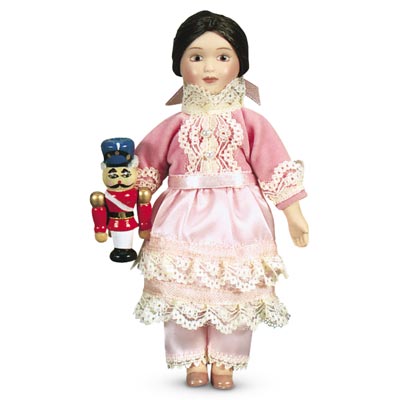
For Christmas, Samantha longed for the beautiful doll she saw in the window of Schofield’s Toy Store. It’s made of porcelain with movable arms and legs. Her hair is tied back in a big pink bow that matches her ruffly party dress. In her arms she carries a tiny wooden nutcracker—the perfect Christmas doll.

The Nutcracker is a two-act ballet with a score by Pyotr Ilyich Tchaikovsky. (The libretto is adapted from E.T.A. Hoffmann's 1816 story The Nutcracker and the Mouse King.)

The original production was not a success.

So when did The Nutcracker make it to the U.S.?

A short version of the ballet, performed by the Ballet Russe de Monte Carlo, was staged in New York City in 1940 by Alexandra Fedorova.

The ballet's first complete United States performance was on Dec. 24, 1944, by the San Francisco Ballet. The New York City Ballet gave its first annual performance of George Balanchine's staging of The Nutcracker in 1954. Beginning in the 1960s, the tradition of performing the complete ballet at Christmas eventually spread to the rest of the United States.

Wait a minute! Do you think Samantha's the same Samantha I met in St. Louis? Maybe she became a time traveler, too!


Friday, December 23

'Twas the night before Christmas


Then they gathered around the fire with Margaret in the circle of her father's arm, and Betsy read from Dickens' Christmas Carol, the story of the Cratchits' Christmas Dinner. Margaret recited 'Twas the Night before Christmas, and Julia read the story of Jesus' birth out of the book of Luke. Later they turned out the lights to fill one another's stockings which were hung around the fireplace.
Heaven to Betsy 
Maud Hart Lovelace

A Visit from St. Nicholas, also known as The Night Before Christmas and 'Twas the Night Before Christmas, is a poem first published anonymously in the Troy, N.Y., Sentinel on Dec. 23, 1823. Clement Clarke Moore allegedly wrote it for his children but, being a scholar and professor, did not wish to be connected with the poem until they insisted that it be included in an 1844 anthology of his works.
'Twas the night before Christmas, when all thro' the house
Not a creature was stirring, not even a mouse;
The stockings were hung by the chimney with care,
In hopes that St. Nicholas soon would be there;
The children were nestled all snug in their beds,
While visions of sugar plums danc'd in their heads....

Festivus for the rest of us

You modern Americans have some very strange holiday customs.

Take Festivus.

Festivus is a secular holiday celebrated on Dec. 23 as a way to celebrate the holiday season without participating in its pressures and commercialism.

It was created in 1966 and introduced into pop culture by the TV show Seinfeld.

The holiday includes an unadorned aluminum "Festivus pole," practices such as the "Airing of Grievances" and "Feats of Strength," and the labeling of easily explainable events as "Festivus miracles."

Celebrants of the holiday sometimes refer to it as "a Festivus for the rest of us," a saying to describe Festivus' non-commercial aspect.

At least it was non-commercial until they started selling Festivus poles, etc.


Thursday, December 22

Steamrolling through Christmas

I believe I have mentioned that Momma gets a little weird this time of year. 

One of her Christmas obsessions is Mannheim Steamroller, an American music group known primarily for its modern recordings of Christmas music.

(The name "Mannheim Steamroller" comes from an 18th century German musical technique, Mannheim roller, or Mannheimer Walze in German, and a steamroller which is a type of steam-powered heavy construction machinery
used for leveling surfaces.)

Momma has been to two of their Christmas concerts and has "a lot" of their music.

She's especially pleased that several of her favorite carols were included in Mannheim Steamroller's 1995 Christmas album, Christmas in the Aire.

Christmas in the Aire
was the third Christmas album and 21st studio album released by Mannheim Steamroller.

A year or two before the release of Christmas in the Aire Momma saw a request for song ideas for their unnamed third Christmas album. Among her suggestions was Angels We Have Heard on High - which they included! She got a free copy of the album and a letter of thanks as well as a mention in catalogs at the time. (Sadly, they misspelled her name - sigh.)

She's very happy to see that Angels We Have Heard on High was also included on their latest Christmas Symphony.

What is my favorite thing about Mannheim Steamroller?

Need you ask? The iconic steamroller, of course! 


Wednesday, December 21

Bilbo Baggins 13, Snow White 7

Hmm, I wonder if there is some connection between the shortest day of the year and dwarfs -- or dwarves.

Coincidence? I think not.

Why else would the long awaited trailer for The Hobbit be released today, Dec. 21, 2011.

The Hobbit
Sept. 21, 1937
(or Dec. 21, 2011) 

  • Thorin Oakenshield
  • Fili
  • Kili
  • Oin
  • Gloin
  • Dwalin
  • Balin
  • Bifur
  • Bofur
  • Bombur
  • Dori
  • Nori
  • Ori 

Snow White and the Seven Dwarfs
Dec. 21, 1937
  • Doc
  • Grumpy
  • Bashful
  • Sleepy
  • Happy
  • Sneezy
  • Dopey

It looks like 1937 was a good year for dwarves -- or dwarfs.

Incidentally, J.R.R. Tolkien deliberately used dwarves, which corresponds with elf and elves -- or scarf and scarves. The original editor of The Hobbit "corrected" Tolkien's plural of dwarves to dwarfs, as did the Puffin paperback edition of The Lord of the Rings.

Whatever.

Happy Winter Solstice!


Snow White and the Eight Dwarfs

Snow White and the Seven Dwarfs, the world's first full-length animated feature, premiered on  Dec. 21, 1937 to critical acclaim at the Carthay Circle Theater in California.

Based upon the German version of Snow White first published in 1812 by the Brothers Grimm, it featured the magic mirror, poisoned apple, glass coffin, and the seven dwarves. (The dwarves first received names in a 1912 Broadway play Snow White and the Seven Dwarfs and were then given different names in Disney's version.)

Before Snow White and the Seven Dwarfs, the Disney studio had been primarily involved in short Mickey Mouse and Silly Symphony cartoons. Disney hoped to expand his studio's prestige and revenues by moving into full-length features.

Disney had to fight to get Snow White and the Seven Dwarfs produced, and the Hollywood movie industry referred to it as "Disney's Folly." He even had to mortgage his house to help finance the film's production, which eventually cost $1,488,422.74, a huge amount for a moving picture in 1937.


Tuesday, December 20

The festival of lights

Tonight I'm off to New York City to learn about Hanukkah, but I'll let my friend Rebecca Rubin tell her story.

Rebecca is a girl growing up in New York City in 1914, who celebrates treasured traditions passed down through her Russian-Jewish family. With a little creativity, Rebecca learns how to stay true to her heart as she follows her dreams in the big city.

Rebecca is troubled when her teacher assigns her class to make Christmas decorations. Rebecca's family is Jewish and doesn't celebrate Christmas, but her teacher says Christmas is a national holiday, for all Americans to celebrate. Yet Rebecca knows she's as American as anyone else, even without celebrating Christmas! She wants to please her teacher, but she's sure her family will be upset. Then, on the first night of Hanukkah, Rebecca finds kindness in an unexpected place, and learns the real meaning of the holiday season. 

Rebecca can't wait to light the menorah and celebrate Hanukkah, the Jewish Festival of Lights! This set features:
  • A beautiful menorah and nine pretend candles
  • A dreidel Rebecca and her cousins spin to play games
  • Three shiny coins, called gelt
(Hanukkah begins at sunset on Tuesday, Dec. 20, 2011, and ends at sunset on Wednesday, Dec. 28, 2011.


Sunday, December 18

How the Grinch stole my heart

I can never quite decide which is my favorite classic Christmas cartoon: Charlie Brown vs. The Grinch.


How the Grinch Stole Christmas! is an animated television special  based upon the children's story written and illustrated by Dr. Seuss. 

Published as a book by Random House in 1957, and at approximately the same time in an issue of Redbook, the story of the Grinch criticizes the commercialization of Christmas and those who profit from it.

(Hmm, did Charlie Brown grow up to be the Grinch?) 

Directed by Chuck Jones, the special first aired on Dec. 18, 1966, and is one of the very few Christmas specials from the 1960s to still be shown regularly on television. 

Momma and I simply do not acknowledge the Nov. 17, 2000 feature-length version since We do not like it. 


Saturday, December 17

God bless us, every one!

Hard to believe it now, but A Christmas Carol by English author Charles Dickens used to scare me.

Yes, me.

First published on Dec. 17, 1843, the novella (which met with instant success and critical acclaim) is about stingy Ebenezer Scrooge's transformation after supernatural visits.

Dickens divided the book into five staves, or stanzas, in keeping with the title of the book.

Stave 1

The tale begins on Christmas Eve seven years after the death of Ebenezer Scrooge's business partner Jacob Marley. Scrooge is established as a greedy and stingy businessman who has no place in his life for kindness, compassion, charity, or benevolence. After being warned by Marley's ghost to change his ways, Scrooge is visited by three additional ghosts "each in its turn" who accompany him to various scenes with the hope of achieving his transformation.

Stave 2

The Ghost of Christmas Past takes Scrooge to the scenes of his boyhood and youth which stir the old miser's gentle and tender side by reminding him of a time when he was more innocent.

Stave 3

The Ghost of Christmas Present takes Scrooge to several radically differing scenes (a joy-filled market of people buying the makings of Christmas dinner, the family feast of Scrooge's near-impoverished clerk Bob Cratchit, a miner's cottage, and a lighthouse among other sites) in order to evince from the miser a sense of responsibility for his fellow man.

Stave 4

The Ghost of Christmas Yet to Come harrows Scrooge with dire visions of the future if he does not learn and act upon what he has witnessed. Scrooge's own neglected and untended grave is revealed, prompting the miser to aver that he will change his ways in hopes of changing these "shadows of what may be."

Stave 5

Scrooge awakens Christmas morning with joy and love in his heart, then spends the day with his nephew's family after anonymously sending a prize turkey to the Crachit home for Christmas dinner. Scrooge has become a different man overnight, and now treats his fellow men with kindness, generosity, and compassion, gaining a reputation as a man who embodies the spirit of Christmas. The story closes with the narrator confirming the validity, completeness, and permanence of Scrooge's transformation.

The tale was viewed as an indictment of 19th century industrial capitalism and has been credited with restoring Christmas to one of merriment and festivity after a period of sobriety and somberness. A Christmas Carol remains popular, has never been out of print, and has been adapted to stage, film, opera, and other media.