Showing posts with label yellow fever. Show all posts

Friday, October 21

The Wonderful Adventures of Mary Seacole

I was intrigued to read that while Florence Nightingale and 38 nurses left London on Oct. 21, 1854 for the Crimean War, one nurse did not.

Mary Seacole, a creole woman of mixed-race from Jamaica. And I had never heard of her.

Seacole was taught herbal remedies and folk medicine by her mother, who kept a boarding house in Kingston, Jamaica for disabled European soldiers and sailors.
Drawing on her experience with tropical diseases such as Yellow Fever, Seacole traveled to London to volunteer as a nurse.

She applied to the War Office and asked to be sent to the Crimea but was refused, mainly because of prejudice against women's involvement in medicine at the time. (Nursing was still usually done by prostitutes and other women of desperate means.)

The British Government changed its mind but she was not included in the party of 38 nurses chosen by Nightingale, probably due to her darker skin color.

So Seacole borrowed the money to make the 4,000-mile journey by herself. 

Seacole was impoverished after the war ended and she returned to London. A benefit concert was held in her honor:
She gave her aid to all in need
To hungry, sick and cold
Open hand and heart, ready to give
Kind words, and acts, and gold
And now the good soul is "in a hole"
What soldier in all the land
To set her on her feet again
Won't give a helping hand?


Punch
Dec. 6, 1856
Sadly, Nightingale didn't have kind things to say about Seacole. Did she have just reasons, or was "The Lady with the Lamp" guilty of the petty prejudices of the times?


Monday, September 12

I spy with my occhiolino*


 I. Am. So. Excited.

I found out last week the pastor of my church makes beautiful working telescopes and microscopes out of spare parts. When he saw my excitement he offered me my very own microscope!

It is amazing!

It's made of a Canadian drill press, parts from a brass bed, a ladies mirror, and miscellaneous other things. (He showed me a telescope he made using a roll bar, soup can, and a drive shaft!)

Examining the yellow fever virus.
Inspired by ma chère amie Cécile, I immediately set out to find a cure for yellow fever.

(As you might recall, the New Orleans epidemic of 1853, featured in the Cécile Rey American Girl book series, killed 9,000 people.)

Carlos Finlay, a Cuban doctor and scientist, first proposed in 1881 that yellow fever might be transmitted by mosquitoes rather than direct human contact.

U.S. Army physician Major Walter Reed, M.D., led the team that proved Finlay's hypothesis in 1900.

I thought I might try to nudge both men along with their discoveries.

Or maybe I'll do it myself.

Can't you just see me winning the Nobel Prize?

I can't believe it! My very own steampunk microscope!

Now if I can just get a giant telescope....


*Galileo called his compound microscope the "occhiolino" or "little eye."

Wednesday, August 17

The birthplace of America

Ahh, Philadelpia. I knew I loved thee. 

The President's House in Philadelphia
Our Founding Fathers signed the Declaration of Independence there on July 4, 1776 and it served as one of the nation's many capitals during the Revolutionary War.

When the U.S. established its Constitution by signing it in Philadelphia on Sept. 17, 1787, the question of its capital city arose.

Many cities desired to be the national capital but none was willing to concede to the others. Also, there was rivalry between the proposed 13 States of the United States as to which one would contain the capital city.

A compromise was reached to establish a federal district separate from any of the states, and this would contain a brand-new city for the capital. The new capital district was given the name District of Columbia, and the capital city of Washington was founded within it.

After the July 1790 Residence Act, Philadelphia served as the temporary national capital for 10 years, beginning Aug. 17, 1790, during the construction of Washington, D.C.

President George Washington occupied The President's House in Philadelphia at 524-30 Market Street from November 1790 to March 1797, and President John Adams occupied it from March 1797 to May 1800.

Historic events at the house included the signing of the Fugitive Slave Act of 1793 (boo hiss!) and the Alien and Sedition Acts.


In 1793, one of the largest yellow fever epidemics in U.S. history killed as many as 5,000 people in Philadelphia, roughly 10 percent of the population.

The state government left Philadelphia in 1799 and the federal government left soon after in 1800, but the city continued to be a major force and maintain its reputation of Brotherly Love.

Monday, August 8

Bring out yer dead

First Samantha, then Kirsten, followed by Felicity. Who is next? No one knows but some are fearful with the introduction of a Yellow Fever epidemic in 1853 New Orleans....

The Dead Collector: Bring out yer dead. 

(American Girl® puts a body on the cart.)

AG: Here's one. 

The Dead Collector: That'll be a half-dime.

Addy Walker: I'm not dead.

The Dead Collector: What? 

AG: Nothing. There's your half-dime

Addy®: I'm not dead. 

The Dead Collector: 'Ere, she says she's not dead. 

AG: Yes she is. 

Addy®: I'm not. 

The Dead Collector: She isn't. 

AG: Well, she will be soon, she's very ill. 

Addy®: I'm getting better. 

AG: No you're not, you'll be stone dead in a moment. 

The Dead Collector: Well, I can't take her like that. It's against regulations. 

Addy®: I don't want to go on the cart.

AG: Oh, don't be such a baby. 

The Dead Collector: I can't take her.

Addy®: I feel fine.

AG: Oh, do me a favor.

The Dead Collector: I can't.

AG: Well, can you hang around for a couple of months? She won't be long.

The Dead Collector: I promised I'd be at the McIntire's®.

AG: Well, when's your next round?

The Dead Collector: Next year.

Addy®: I think I'll go for a walk.  

AG: You're not fooling anyone, you know. Isn't there anything you could do?

Addy®: I feel happy. I feel happy.
(The Dead Collector looks around furtively, then archives Addy® with a whack of his club.)

AG: Ah, thank you very much.

The Dead Collector: Not at all. See you next year.

AG: Right. 

With major apologies to American Girl, Addy, and 1975's Monty Python and the Holy Grail.


We'll always have parrots

Oh my.

I am speechless, and as you probably know by now that doesn't happen very often.

American Girl put ma chère amie Cécile (and her friend Marie-Grace) on pre-sale last night.

While I am certain Marie-Grace (far right) is a very nice girl, she just doesn't interest me yet.

Parts of their collections are fabuleuse! and I can't wait to acquire them, but other pieces though are, um, well, répugnant in My Not So Humble Opinion.

And I can't decide where to start.

Should it be Cécile's Fabulous Parrot, Cochon? (What self-respecting pirate doesn't want a parrot?) But would someone please tell me why her parrot is called "Pig"?

Or the Pink Ruffled Crinoline I wouldn't be caught dead in - and please remember I don't say that lightly since a Yellow Jack epidemic is a major theme in their 1853 New Orleans stories! (One AG fan was disappointed that no "plague cart" was among the accessories!)

At least Addy's Crinoline was a plain (if boring) muslin. And My hoopskirt is black!

J'adore Cécile's Special Dress and think it would look magnifique on Me - with a few steampunk additions of course.

And the fancy gold boots. Gold boots! (I can't decide if I love 'em or hate 'em.) Did the designers hit the bourbon too hard while visiting Bourbon Street?

I can't even bring myself to look at the Fancy Dress & Fairy Costume photos again (Now you know why my eyes are weak!) so you'll have to look for yourself.

Check out Cécile and Marie-Grace's complete collection yourself. And please tell me what you think!

Meanwhile, Cécile and I shall always have parrots.

(BTW, I love everything in this catalog photo!)


Wednesday, July 27

If it happens, it happens... We can't stop living

Since I just wrote about Yellow Fever on Monday, I was interested to read that Walter Reed Army Medical Center held a ceremony today in preparation for its September closing. The hospital has treated the nation’s war wounded since 1909.

During the yellow fever epidemic of 1793,
Philadelphia authorities sent carriages around the city
to pick up the dead and dying.
Major Walter Reed, M.D., was a U.S. Army physician who in 1900 led the team that discovered that Yellow Fever is transmitted by mosquitoes, not humans.

(Sadly, Reed underwent an emergency appendectomy and died of complications within those same hospital walls in 1902.)

Although the last North American epidemic of Yellow Fever occurred in New Orleans in 1905, yellow fever epidemics in North America have caused about 100,000-150,000 deaths through the years.

(The New Orleans epidemic of 1853, featured in the upcoming Cécile Rey American Girl book series, killed 9,000 people.)

A 1793 outbreak in Philadelphia resulted in the deaths of several thousand people and forced the administration to flee the city, including president George Washington.

A church in Charleston, S.C. suffered 308 Yellow Fever deaths in 1858, reducing its congregation by half.

In 1873, Shreveport, La., lost almost a quarter of its population to Yellow Fever, and in 1878, about 20,000 people died in an epidemic in the Mississippi River Valley.

In 1878 Memphis was hit with an unusually large amount of rain, which led to an increase in the mosquito population. The result was a huge outbreak of Yellow Fever. A ship took people fleeing Memphis hoping to escape the disease, but the ship was not allowed to dock anywhere due to fear of Yellow Fever. The ship roamed the Mississippi for the next two months before unloading her passengers.

Signal flag called the "Yellow Jack."
Yellow Fever was sometimes known as Yellow Jack. Why? A ship flying a yellow flag meant that there was illness aboard. Often this was used to trick pirates away from potential targets.

Huh. I thought a jack was a pirate flag but turns out it's a small flag flown from any boat or ship.

Anyway, thanks for a job well done Walter Reed Army Medical Center.


Monday, July 25

Meet Cécile!

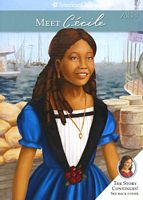
I am so excited! I am soon to be joined by another African American Girl! Her book, Meet Cécile by Denise Lewis Patrick, is not due until Aug. 30, but my anticipation is building.

Set in 1853 New Orleans, the stories revolve around Cécile and her friend Marie-Grace and how their lives are affected by a Yellow Fever outbreak.
Cécile Rey can't wait for Mardi Gras -- New Orleans' dazzling season of parties and costume balls. For the grandest event of all, the Children's Ball, Cecile is determined to come up with a fantastic costume like no one else's. Everyone will notice her! And after Mardi Gras, Cecile's beloved brother, Armand, will finally come home after two long years in faraway France. But Mardi Gras season turns out to be even more exciting than Cecile expects when she meets a new girl named Marie-Grace Gardner. Together they form an unlikely friendship ... and share a daring adventure!

Some claim that I shall be retired when Cécile debuts, but I think they have Me confused with that other Addy doll.

I shall never retire!

In the meantime, if you're looking for great books about 19th century New Orleans I can't recommend the Benjamin January series by Barbara Hambly enough. Make sure you start with A Free Man of Color.